
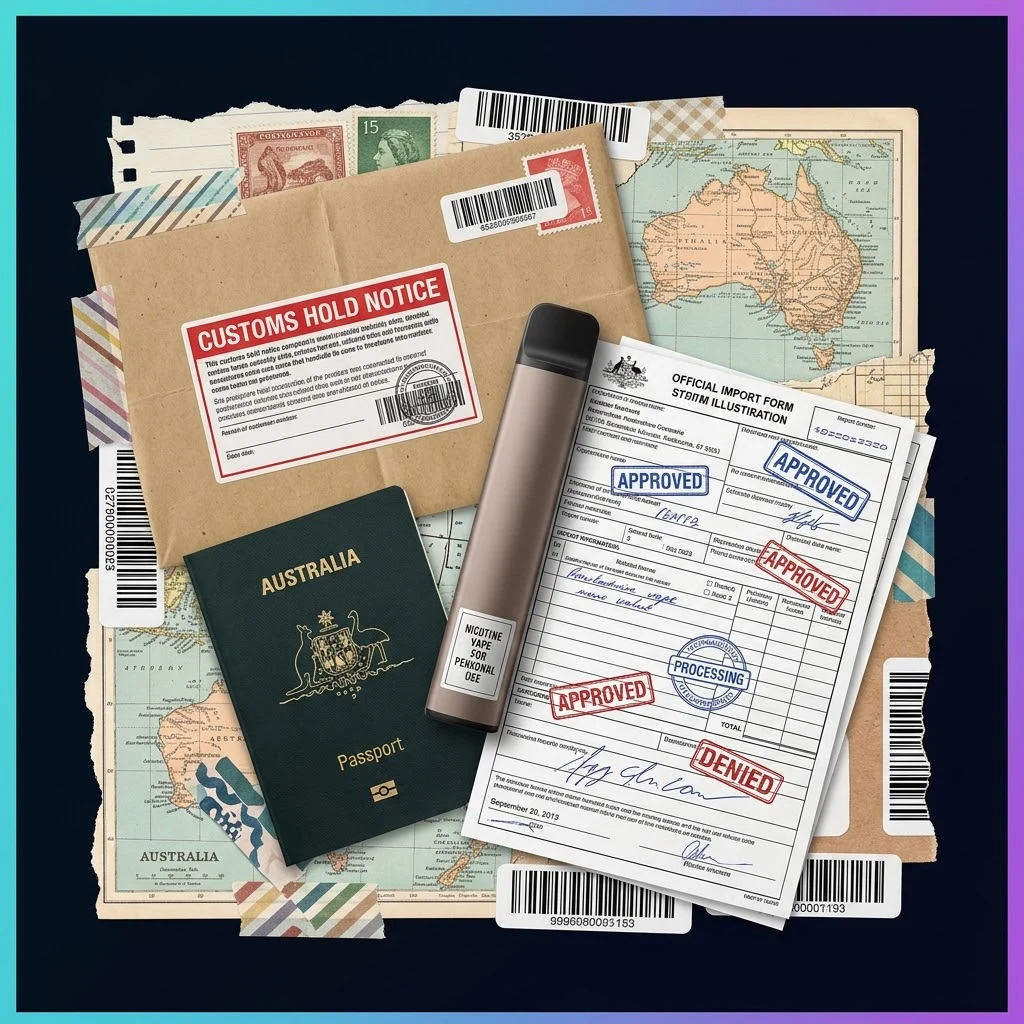
Can I Import Nicotine Vapes for Personal Use in Australia? (2026 Guide)
The Short Answer
Personal import rules for nicotine vapes changed in 2024, and the honest 2026 position is: importing nicotine vapes into Australia for personal use now sits inside the TGA’s prescription-based framework, enforced by the Australian Border Force — and parcels that don’t meet the current rules can be seized and destroyed, with no refund and possible penalties. We deliberately won’t quote a quantity limit, because the framework — not a fixed allowance — is what governs, and the detail has shifted repeatedly since 2024. If you’re weighing up an overseas order, the practical question isn’t “what’s the allowance?” — it’s “can I prove this parcel meets the current rules?” If you can’t answer that, you’re gambling the whole order.
1. Who Regulates Personal Imports: TGA and ABF
Two agencies share the job of regulating nicotine vape imports, and it’s worth knowing which one does what:
- The Therapeutic Goods Administration (TGA) writes the rules. Because nicotine is a scheduled substance, nicotine vaping products are regulated as therapeutic goods — and since 2024, under a prescription-based model. The TGA decides what may lawfully be imported, and under what conditions.
- The Australian Border Force (ABF) enforces the rules at the border. The ABF screens incoming parcels and passengers, intercepts non-compliant nicotine products, and handles seizure and penalties. It doesn’t write the framework; it makes the framework real. The TGA’s compliance guidance confirms the ABF monitors the border and seizes disposable vapes or vaping goods imported without the appropriate licences.
This division matters: your parcel can fail on the rules (it doesn’t fit the TGA framework) or on the enforcement (the ABF intercepts it regardless) — most failed imports fail on both.
2. What Changed in 2024
The single most important fact about personal imports right now is also the simplest: the rules changed in 2024, and they’ve been moving since.
Before you rely on anything you’ve heard about importing vapes — from a forum post, a friend, or a seller’s website — here’s the framework-level picture:
- Personal imports came inside the prescription-based model. The old expectation that you could order nicotine vapes for personal use through ordinary channels stopped being the lawful baseline.
- The change was phased, not instant. The framework arrived in stages, and successive rounds through 2024–2025 refined what importers could rely on.
- “Current” is a moving target. The detail of who can import what, under what conditions, has shifted repeatedly. That’s why every official source — including the TGA and ABF websites — is the authority, and why any article (including this one) is a snapshot, not a statute.
We’re not being evasive when we don’t quote a specific allowance — the framework governs, and specific numbers, where they exist, belong to the current official guidance.
3. How Parcels Actually Get Screened
The enforcement reality is what most overseas orders never account for. The ABF screens international mail and courier parcels, and nicotine vapes are a known category:
- Screening is systematic. Parcels from known source countries, parcels with tell-tale labelling, and parcels flagged by data matching all get attention. The technology and processes have only gotten more capable.
- Seizure is the standard outcome for non-compliant goods. Intercepted nicotine vapes can be held and destroyed — and the buyer is not compensated. The order, the shipping fee and the product are gone.
- Penalties are possible on top. We won’t quote penalty amounts, because they change and local discretion applies — but the point stands: the downside isn’t limited to losing the parcel.
- There’s no “nice warning” guarantee. Enforcement discretion exists, but relying on it is like relying on a speed camera being out of film.
The honest framing: an overseas vape order that doesn’t demonstrably meet the current rules is a bet, not a purchase. The house (the ABF) has the data, the scanners and the repeat experience.
4. Why “It Worked Last Time” Is Not a Strategy
The most common response to all of the above is: “but my mate ordered one last month and it arrived fine.”
That story — true or not — is not a strategy, for three reasons:
- The rules moved. A parcel that complied with the framework in an earlier round may not comply now. The 2024 change wasn’t a one-off; it was the start of a sequence.
- Past delivery isn’t proof of compliance. A parcel that slipped through wasn’t necessarily legal — it was missed. Sellers who claim “guaranteed delivery” are selling the same gamble with better marketing.
- You carry the risk, not the seller. If a parcel is seized, the overseas seller has already been paid. The loss, the questions and any penalty land on you.
The people who lose on imports are rarely the ones who didn’t know the rules existed. They’re the ones who knew, and assumed the rules wouldn’t catch them this time.
5. The Grey Market Trap: Fakes and Unknowns
There’s a second, quieter cost of the import channel: the unregulated import route is the main entry point for counterfeit devices in Australia.
When you buy from a grey-market overseas channel:
- You don’t know what’s in the device. Counterfeit vapes fail on build quality, battery safety, liquid quality and nicotine content — all at once, with no recourse.
- You can’t verify anything. No legitimate batch tracking, no accountability, no warranty. The seller disappears the moment you need them.
- You’re funding the problem you’re trying to beat. The counterfeit trade exists because demand routes around the regulated framework — and every intercepted parcel is a reminder that the grey channel is where the enforcement lands.
The counterintuitive part: in the current environment, a fake vape is often more dangerous than no vape at all — if the import route is closed to you, buy through a channel you can verify, not an unregulated unknown.
6. What to Do Instead of Importing
If overseas ordering is a gamble, what’s the alternative for adult vapers in 2026?
- Buy from real, verifiable Australian retailers. The compliant channel is a retailer that verifies your age, shows its policies, and ships transparently with tracking. That’s the framework working as intended, and the channel where you actually have rights as a customer.
- Check the retailer, not just the price. A genuine retailer’s compliance page, shipping policy and age-verification process are all public signals. Sellers without any of those are the grey channel wearing a shopfront.
- Expect 18+ verification at checkout. That’s not a hurdle; it’s the point where the framework meets you as a customer.
- If you’re still set on importing, read the official sources first — the TGA website for the framework, and the ABF website for current personal import guidance. If the official page doesn’t clearly cover your situation, treat that as your answer.
That’s the standard Cloud Collective operates to: 18+ verification at checkout, genuine stock from our Sydney warehouse, tracked discreet shipping Australia-wide, and free shipping over A$100. Our compliance page walks through how a properly run Australian retailer handles age checks and the regulatory basics — and if you’re comparing sellers, it’s a useful checklist for what a real one looks like.
7. Travelling With Vapes: The Same Rules, In Person
Personal import rules don’t only apply to parcels — they apply to you, at the airport.
- Carry-on only. Vapes and spare lithium batteries must fly in carry-on; checked luggage is prohibited on every airline.
- Returning to Australia is an import. Bringing nicotine vapes back into the country sits inside the same post-2024 framework, and the ABF screens incoming passengers as well as parcels.
- Keep quantities to obvious personal use, and check the ABF guidance before you fly home — the rules you left with may not be the rules you return to.
8. FAQ
Is it legal to import nicotine vapes for personal use in Australia?
Personal import rules changed in 2024, and importing nicotine vapes now sits inside the TGA’s prescription-based framework, enforced by the ABF. Parcels that don’t meet the current rules can be seized and destroyed. Check the current TGA and ABF guidance — the framework is the authority, not any fixed allowance.
How many vapes can I import for personal use?
We won’t quote a number, because the framework — not a fixed quantity allowance — governs, and the detail has shifted repeatedly since 2024. The official ABF and TGA guidance is the only reliable source for what’s currently permitted.
Will my vape parcel get seized by customs?
If it doesn’t demonstrably meet the current rules, seizure is a real and standard risk — the ABF systematically screens international parcels, and non-compliant nicotine products are held and destroyed with no refund. “It worked last time” is not a strategy.
Can I buy vapes from overseas websites in 2026?
You can order — but the order is a gamble unless it demonstrably meets the current import framework. Intercepted parcels are seized and destroyed, penalties are possible, and the grey channel is the main entry point for counterfeit devices.
What happens if my vape is seized at the border?
The parcel can be held and destroyed, and the buyer is not compensated — the product and the shipping cost are gone, and penalties are possible. That’s why buying through verifiable local channels is the practical alternative.
Do the same rules apply when I bring vapes back from overseas travel?
Yes. Returning to Australia with nicotine vapes is an import, inside the same post-2024 framework, and the ABF screens incoming passengers as well as parcels. Check current guidance before you fly home and keep quantities to obvious personal use.