
Do You Need to Prime a Disposable Vape? An Honest Australian Guide
The Short Version
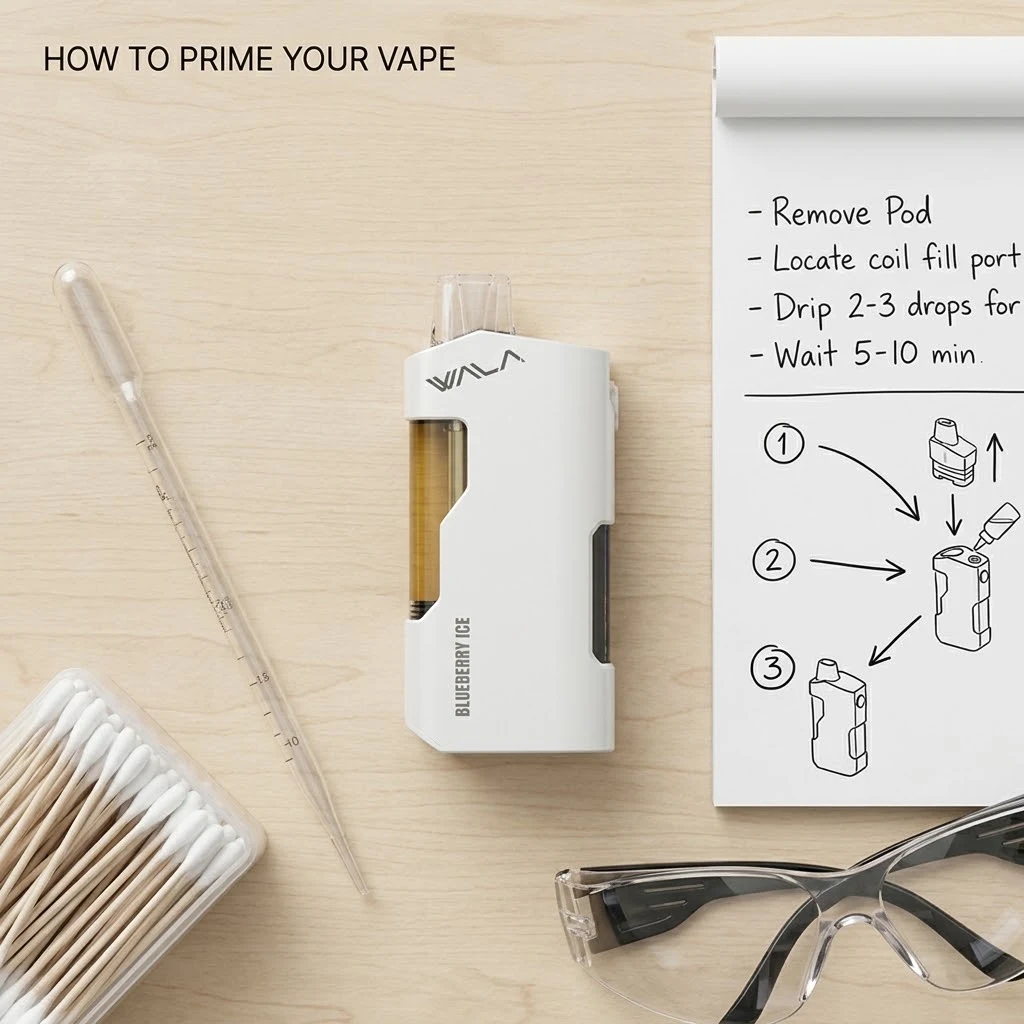
Most modern disposables benefit from a brief “priming” routine: two or three gentle half-pulls, then five to ten minutes upright before your first proper puff. That pause helps the wick saturate evenly and reduces the harsh, dry hit that makes people think a brand-new vape is faulty. If the flavour still tastes burnt after resting overnight, stop using the device rather than trying to open, refill, or force-fix it.
What “priming” actually means
Priming simply means letting the e-liquid soak into the wick before the coil gets serious heat. Inside most disposables there is a small mesh or wire coil wrapped in absorbent material. Liquid travels into that wick slowly. When the wick is patchy, part of it can scorch before it has a chance to carry flavour to your mouth.
This matters more with high-puff devices than with tiny older disposables. A larger tank, denser wick, and mesh coil can need a little time after manufacture, shipping, or temperature swings. Priming will not turn a bad device into a good one. It just gives a normal device the best possible first impression.
You cannot see whether the wick is ready, so there is no point digging around inside the mouthpiece. Your senses are enough: a smooth draw, visible vapour, and flavour without a dry, toasted edge mean you are fine.
The Australian legal backdrop
Vaping rules in Australia are stricter than many people expect. The Therapeutic Goods Administration treats nicotine vaping products as tightly regulated goods, with requirements covering ingredients, packaging, labelling, and supply channels. States and territories also add their own enforcement and public-place rules. Age verification applies everywhere, and products should be stored away from children and pets.
That background matters because packaging can look different from overseas marketing photos, some flavours may be described differently, and a legitimate Australian seller should be willing to answer questions about compliance rather than hiding behind vague claims. Buy from a retailer that checks age, provides clear product information, and does not pretend nicotine-free means risk-free.
When a disposable needs priming
Prime a new disposable when:
- It has been sitting in a warm delivery van, parcel locker, or shop stockroom.
- You live somewhere humid, cold overnight, or very hot during the day.
- The first draw feels thin, papery, sharp, or slightly bitter.
- The device has a large capacity, such as the WALA POP 10,000 Puffs.
- You have carried it loose in a bag and it spent hours on its side.
Do not confuse priming with troubleshooting a dead battery. A charged, working disposable should respond normally when you draw. If the LED never lights, the airflow feels completely blocked, or there are signs of damage, contact the seller instead of forcing it.
How to prime a disposable vape safely
Step 1 — Unbox carefully. Remove outer wrapping and check for cracks, dents, exposed battery, oil smells outside the device, or a leaking mouthpiece. If anything looks wrong, do not use it.
Step 2 — Remove transport plugs only where fitted. Some devices have a silicone bung or sticker sealing the airflow. Remove only what is obviously meant to be removed. Never poke a screwdriver deep into the airway.
Step 3 — Take two or three gentle primer draws. Draw softly for about one second each, lighter than a normal cigarette drag. Think of these as clearing the airway and starting liquid movement, not as full puffs.
Step 4 — Wait five to ten minutes. Stand the device upright if practical. Put the kettle on, unpack the shopping, or sit in the ute for a few minutes before you drive. That wait gives the wick time to equalise.
Step 5 — Start with shorter puffs. For the first few real draws, use about half your usual length. Pause for twenty to thirty seconds between each one. Chain vaping is the fastest way to cook an otherwise healthy coil.
Step 6 — Judge it over a day. Slight variation between the first few puffs is normal. Persistent burnt taste, leaking, gurgling that will not clear, overheating, or a swollen body are not normal.
For rechargeable disposables, charge only with the supplied cable or a certified low-power USB adapter. A laptop port or quality phone wall adapter is safer than a high-output fast charger. Never charge it unattended on bedding, the couch, or near curtains.
If it already tastes burnt
A faintly dry first puff can recover. A properly burnt taste usually cannot.
Try this order:
- Stop puffing immediately. More heat turns a damp-dry wick into a scorched wick.
- Stand the device upright for thirty to sixty minutes in a room-temperature spot.
- Take one very soft primer draw, then wait ten minutes.
- Try a short, gentle puff. If flavour returns, keep sessions moderate for the rest of the day.
- If the burnt edge remains after twenty-four hours, retire the device.
Please do not squeeze the tank, suck liquid out, add water or another e-liquid, microwave it, put it in the sun, or open the housing. Those tricks can cause leaks, battery damage, and contamination. A$30 to A$60 is annoying to lose, but a damaged lithium battery is worse.
Common mistakes that kill coils
- Chain puffing at smokos. Ten long draws in two minutes starves the wick faster than most people expect.
- Leaving it in direct sun. A dashboard, windowsill, or steel ute tray can get far hotter than the air around it.
- Storing it mouthpiece-down. Liquid can pool near the airflow and flood the coil.
- Using phone fast chargers. Rechargeable disposables are not designed for maximum-wattage charging.
- Assuming more puffs means longer drags. A “10,000 puff” rating assumes controlled testing, not ten-second lung hits.
- Trying to repair it. Disposables are sealed. Once the coil is cooked or the seal is compromised, replacement is safer.
Summer heat, cars, and servo stops
Australian summer can undo careful priming quickly. E-liquid thins in heat, seals are stressed, batteries dislike extreme temperatures, and flavour degrades faster. On a February drive, a device left on the passenger seat with the aircon off can easily reach temperatures no manufacturer intends.
At a servo stop, resist the temptation to leave it on the dash while you pay. Keep it in your pocket or a cool bag section, out of sunlight, and away from keys or coins that could press against the button if your model has one. If the vape has been sitting in a hot car, let it return to room temperature before heavy use. Cold liquid and hot electronics are a poor mix.
If you buy a high-capacity device on a road trip, ask staff to pack it sensibly and check it before you leave the counter. A quick look for leaks, cracks, and clear airflow takes seconds and saves arguments later.
Puff counts, prices, and real-world value
Manufacturers’ puff counts assume average draw length and controlled conditions. Real users often get fewer because they take longer, warmer puffs, chain vape, or store the device badly. Treat ratings as comparisons between models rather than guarantees.
As a rough Australian retail guide:
| Device class | Typical shelf price | Practical expectation |
|---|---|---|
| Compact 600–800 puffs | A$15–A$30 | Handy backup, but poor value per puff |
| Mid-size 6,000 puffs | A$25–A$40 | Good balance for occasional users |
| WALA POP 10,000 Puffs | A$52 | Often better value per puff if storage habits are decent |
| Alibarbar Ingot 9000 9,000 puffs | A$60 | Higher capacity feel, but still sensitive to heat and chain puffing |
| Very large 16,000–18,000 puffs | A$55–A$85 | Only worthwhile if you genuinely finish it fresh |
Price alone does not tell you much. A A$42 device kept upright at room temperature and used with pauses can taste better at puff eight thousand than a A$65 device left in a hot glovebox. Browse current models on the all vapes page and compare what suits your usage pattern.
Related: how to save a dying vape battery and the first-time buyer checklist.