
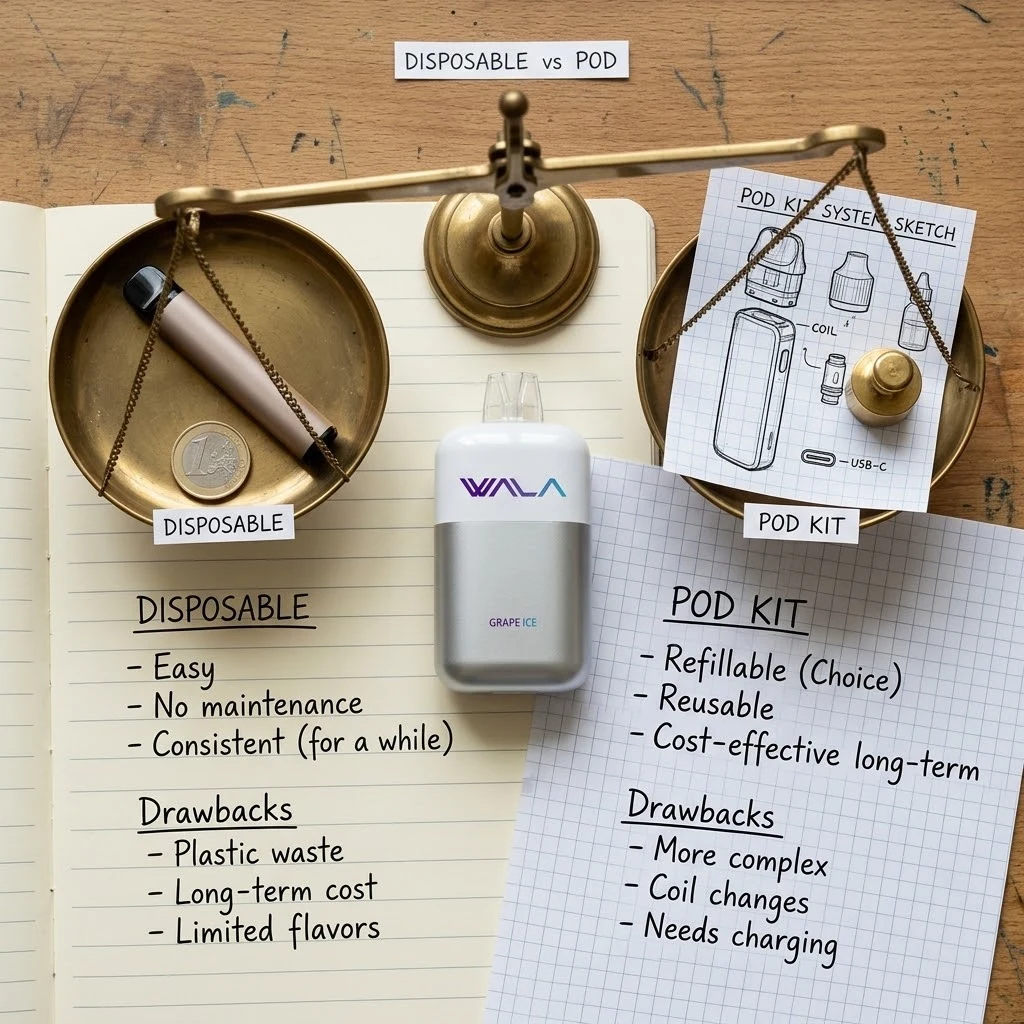
Disposable Vape vs Pod System: Which Should You Buy in 2026?
The Short Version
A disposable suits you if you want the least fuss, predictable upfront pricing around A$35–A$95, and no bottles, coils, or charging routine beyond topping up a rechargeable model. A pod system usually costs less per week once it is running, but it asks more of you: charging, refilling or replacing pods, cleaning contacts, and carrying a small kit. If you mainly want a big-capacity, sealed device for road trips, FIFO swings, festivals, or “I don’t want another thing to maintain”, start with Browse All and choose a clearly labelled model such as the WALA POP 10000 rather than buying an unbranded device from a servo drawer.
Table Of Contents
- What “disposable” really means
- What a pod system actually involves
- Cost, puffs, and real-world value
- Flavour, draw, and everyday reliability
- Australian rules in plain language
- Heat, cars, servos, and summer storage
- How to decide without overthinking it
- Care, safety, and disposal
- FAQ
What “Disposable” Really Means
A modern disposable combines battery, coil, airflow path, wick, and pre-filled liquid in one sealed unit. Most large-capacity models now use USB-C recharging so you can finish the supplied liquid before the cell runs flat. When the coil or liquid is finished, the whole device is replaced.
That does not mean every disposable is careless design. A good one has consistent draw, clear labelling, batch information, sensible warnings, and a mouthpiece that does not collect lint immediately. It also means fewer mistakes for someone who does not want to learn wattage ranges, coil priming, or bottle handling after work.
The trade-off is waste and less flexibility. You cannot swap flavours mid-session unless you carry two devices, and when something fails internally there is nothing sensible to repair. If the shell gets crushed in a car door, the safest move is replacement—not DIY surgery.
For many Australians, though, the appeal is practical. A sealed device lives in a glovebox-safe container, works after a twelve-hour shift, and needs no setup at 6am. Models such as the WALA POP 10000 are rated at 10,000 puffs, which makes them closer to a travel-size kit than the tiny bars people remember from a few years ago.
What A Pod System Actually Involves
A pod system separates the reusable battery from the pod that holds liquid and the heating element. You recharge the battery, click in a fresh pod when it runs dry or tastes tired, and occasionally clean the contact points and base.
In theory, this gives you better control. You can choose lower-strength nicotine for weekdays and something different for the weekend, carry spare pods instead of several full devices, and reduce the amount of electronic waste created by each puff. A compact refillable system can also be cheaper across months if you buy well and look after the hardware.
But it is not automatic savings. Pods dry out if they sit in a hot car. Coils suffer if you chain-puff on a 38°C day. Cheap third-party pods can leak into the connector. Bottled liquid requires careful storage away from children and pets. If you lose the charger, put the pod upside-down in a bag pocket, or ignore the first burnt note, the “cheap” option becomes annoying quickly.
A pod system rewards routine. Charge it beside your keys, wipe the base weekly, keep spare pods sealed and cool, and stop drawing hard when the flavour thins. If that sounds like normal life, it can be a good fit. If it sounds like homework, a sealed disposable will probably make you happier.
Cost, Puffs, And Real-World Value
Sticker price is the wrong place to stop. Think about how often you actually replace the device, whether you share it, and what happens in summer.
As a broad Australian guide:
| Option | Typical upfront cost | What you get | Realistic fit |
|---|---|---|---|
| Small disposable | A$15–A$30 | Compact, low-capacity, easy to lose | Occasional use, short trips |
| Large rechargeable disposable | A$35–A$95 | Often 8,000–18,000 labelled puffs | Regular users who want no maintenance |
| Basic pod kit | A$30–A$95 | Battery plus one or two pods | Users happy to charge and change pods |
| Replacement pods/liquid | A$15–A$40 depending on pack size | Ongoing running cost | Works best with care and storage |
Puff counts are benchmarks, not promises. A WALA POP 10000 is rated for 10,000 puffs. If four people pass it around at a barbecue, take long direct-lung draws, leave it on a hot dashboard between turns, and finish it over two weekends, nobody should expect factory-count performance. Gentle mouth-to-lung draws with pauses usually land much closer to the label.
The same applies to the ALIBARBAR Ingot 9000: its 9,000-puff rating describes controlled testing, not a guarantee for every person, climate, or sharing session. Treat any advertised number as a ceiling, not a contract.
If you vape rarely, a smaller purchase may waste less money than a high-capacity device sitting unused until its liquid degrades. If you vape regularly, calculate your weekly spend honestly and include the pods or devices you abandon early.
Flavour, Draw, And Everyday Reliability
Disposables are tuned for consistency. The manufacturer matches liquid, wick, coil, airflow, and power, so most puffs feel familiar until the liquid or coil nears the end. Flavours such as mango, watermelon ice, grape, berry blends, cola, and mint remain popular in Australia because they survive travel and heat reasonably well when stored correctly.
Pod systems give more room to adjust, but also more ways to get it wrong. A slightly loose pod can gurgle. A worn pod can mute the flavour before it tastes burnt. A refillable pod can flood if you overfill it or draw too hard while it is cold. None of this means pod systems are bad; it just means they need a bit more patience.
Reliability often comes down to handling. Do not stand on it in a back pocket, do not let keys press the button or inlet, and don’t test a suspiciously cheap clone. A genuine device from a retailer that answers questions is worth a few dollars more than mystery stock with no batch details.
Australian Rules In Plain Language
Australia’s nicotine vaping rules sit under federal TGA settings, with additional controls imposed by states, territories, pharmacies, customs, and retailers. Those settings changed substantially during recent years and continue to affect packaging, nicotine limits, permitted channels, advertising, and age verification.
Practically:
- Buy only from an outlet that treats age verification and compliance seriously.
- Read the current TGA guidance and your state or territory health advice before ordering.
- Check nicotine strength, ingredient labelling, child-resistant packaging, and batch details.
- Keep products away from children, pets, and anyone under 18.
- Never assume a rule you saw in 2023 still applies unchanged in 2026.
Cloud Collective’s Compliance Notice exists because these details matter. If a seller cannot explain basic age checks or product provenance, walk away.
Heat, Cars, Servos, And Summer Storage
Australian summers are hard on batteries and liquid. A cabin can exceed 45°C long before the afternoon feels unbearable. A dashboard is worse. Liquid thins, seals stress, flavours drift, and battery chemistry ages faster. Cold winter mornings can also thicken liquid and mute flavour until the device returns to room temperature.
Do not leave any vape on the dashboard, parcel shelf, tool tray, or direct sun through a window. At a servo roadhouse, keep it in a shaded bag rather than clipped to a sun visor. On a construction site or farm, avoid dust in the airflow inlet and never store it loose with metal tools. On public transport, respect smoke-free and vape-free rules; “it’s just flavoured” does not settle an argument with a driver or inspector.
For long drives, use a hard case or zipped pocket away from direct sunlight. If a device has been baking in a hot car, let it return to room temperature before charging. If it is swollen, leaking, unusually hot, cracked, or smells chemical, stop using it and dispose of it safely at an appropriate drop-off point.
For the full playbook on bags, cars and long-term storage in Australian heat, see our guide: How to Store a Disposable Vape.
How To Decide Without Overthinking It
Choose a large rechargeable disposable if:
- You want no refilling, coils, or spare parts.
- You prefer one sealed flavour per device.
- You travel, work shifts, camp, fish, or attend festivals.
- You want a simple upfront price between A$35 and A$95.
- You are replacing an older habit and want fewer moving parts while adjusting.
Choose a pod system if:
- You like changing strength or flavour without carrying multiple full devices.
- You are comfortable charging a battery and swapping pods.
- You want less waste per month and are willing to build a routine.
- You have somewhere cool, dark, safe, and out of reach for spares.
- You would rather pay gradually for pods than replace complete units.
There is no moral prize for picking the complicated option and no shame in choosing convenience. The best choice is the one you can use safely, store responsibly, and afford without pretending the label count will always match real life.
Care, Safety, And Disposal
Use the supplied cable where possible, or a certified USB-C cable with a reputable phone charger or laptop port. Avoid fast-charging bricks intended for laptops, cheap gas-station cables, power banks left in the sun, and overnight charging. Unplug if the body becomes uncomfortably warm.
Store upright with the mouthpiece protected, away from sunlight, radiators, dashboards, ovens, and metal objects. Keep spare pods and liquids in original child-resistant packaging, ideally below 25°C, and never in reach of children or pets.
If flavour goes burnt, rest the device upright at room temperature for several hours. Try shorter draws with longer pauses. If the acrid taste remains after 24 hours, the coil is finished—do not keep hammering it. If it gurgles, wipe the mouthpiece, stand it upright, and avoid blowing liquid deeper inside.
Used vapes contain lithium batteries and electronics. Kerbside recycling is not suitable. Take them to a battery or e-waste collection point, council transfer station, participating retailer, or community hazardous-waste event. Tape exposed terminals where required and keep damaged devices separate from flammable material until disposal.
Related: how long disposables last and the first-time buyer checklist.
Related: what a COREX mesh coil is and how it changes flavour.