
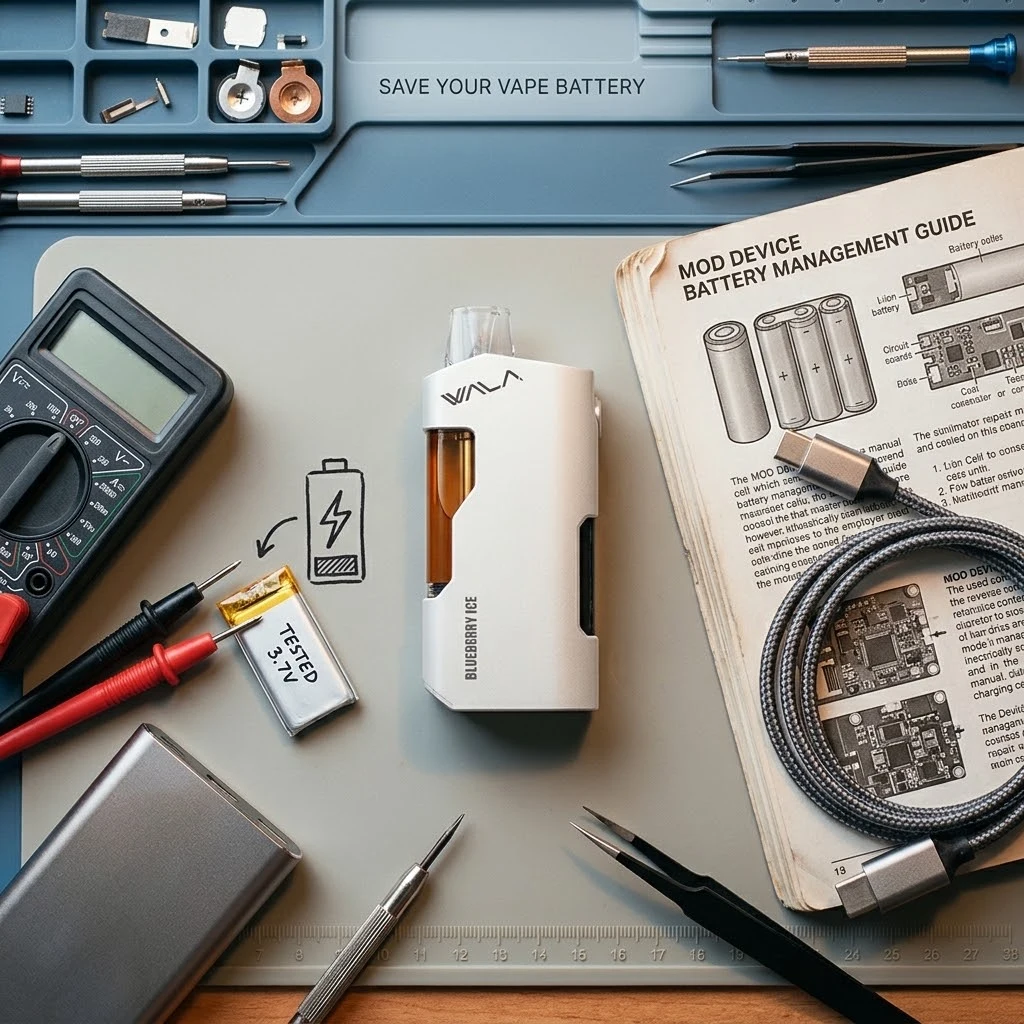
How to Save a Dying Vape Battery: Last-Resort Tricks That Will Not Make Things Worse
The Short Version
A “dead” rechargeable disposable often has three separate problems — an empty battery, a locked-out protection circuit, or a dry/burnt coil — so a short rest and one careful low-power charge are worth trying before you bin it. Never open, puncture, crush, bake, freeze, or overcharge a lithium device, and take it off charge once the light settles or reaches full. If it gets hot, smells strange, bulges, leaks, hisses, tastes burnt after resting, or simply refuses to work again, retire it safely and take it to a battery/e-waste drop-off point instead of forcing a few extra puffs.
What is actually dying?
Most people say “my battery died” when the real fault is not that simple. A modern disposable contains a small lithium cell, a charging/protection board, an airflow sensor, a coil wrapped around wicking material, and flavoured e-liquid. Any one of those can fail while everything else still works.
If the light blinks when you draw, the battery or control board is usually protecting itself. If the light comes on but vapour is thin, the cell may be too low to heat the coil properly. If there is plenty of vapour but the flavour turns harsh, the battery is probably fine — the coil or wick is the problem. That distinction matters because more charging will not fix a burnt coil, and more waiting will not fix a failed airflow sensor.
Rechargeable disposables such as the WALA POP 10000 Puffs, WALA YO 18000 Puffs and IGET BAR PRO 10000 Puffs are designed to be topped up during their life, not run completely flat and then revived days later. Sealed devices like the ALIBARBAR Ingot 9000 and IGET One 12000 skip that problem entirely — their cells are calibrated to outlast the liquid. Lithium cells dislike being stored at zero per cent. Every week spent flat makes recovery less likely, especially after an Australian summer.
Five-minute triage before you charge
Start on a hard, non-flammable surface such as a kitchen bench, away from paper, bedding, curtains and petrol fumes. Check the body for dents, swelling, leaking liquid or a burnt smell. If any of those are present, stop. Do not charge it and do not put it in a drawer with keys.
Next, look at the USB-C port. Pocket lint can compress into the port until a cable cannot seat properly. Hold the device upright, use a wooden toothpick and gentle sideways light — not a metal pin — to remove visible fluff. Plug the cable in lightly and see whether it sits straight. A loose or wobbly connection is common after a device has lived in a car console or gym bag.
Then let the device rest for ten minutes if it has just been in direct sun, a hot car, or a pocket for hours. A warm lithium cell needs to cool before charging. Room temperature in most Australian homes — roughly 20–25°C — is ideal. Charging a hot device stresses the cell and can trigger the same lockout you are trying to clear.
Safe last-resort charging steps
Use the cable supplied with the device when possible. If you lost it, use a known-good USB-C data cable and an ordinary phone wall adapter rated 5V/1A or a laptop USB-A port through a compliant cable. Avoid high-output fast-charge bricks, car sockets on long drives, cheap gas-station chargers and unknown cables from a bottom drawer.
Plug in for 15 minutes only, then feel the case. Warm is normal. Hot, uncomfortable-to-hold or smelling sweet/chemical is not. Unplug immediately if the LED flashes rapidly, the device hisses, or you notice heat spreading near the port.
After 15 minutes, wait two minutes and try two gentle draws rather than a chain of long puffs. Many boards wake up after reaching a small charge threshold. If nothing happens, try another cable and plug before assuming the cell is dead. If the light turns solid or changes colour to show “full”, unplug. Do not leave it connected while you watch TV or go to bed.
If it charges but dies unusually quickly, the cell has lost capacity. You may get a few more sessions, but treat that as borrowed time. Plan a safe replacement instead of repeatedly draining it to zero.
Australian summer, cars, servos and storage mistakes
Heat is the fastest way to age a small vape battery. A parked car in Sydney, Perth or Darwin can pass 40°C well before lunch, and a dark dashboard can get far hotter. A servo forecourt in January can feel like an oven: the aircon helps you, not the vape on the seat. Leaving a device in a ute tray, glovebox, tool box or school bag next to a sports bag can shorten both battery life and flavour.
At home, avoid windowsills, clothes dryers, hot water systems, garages and the top of a fridge. Store a spare upright or standing on its base, capped/switched off if the model supports it, at room temperature and away from children and pets. A cupboard in an air-conditioned room is better than a bathroom or shed.
For long gaps between uses, a partial charge is safer than a full battery or a dead battery. Around half charge causes less stress for lithium cells. Do not refrigerate a vape to “protect” it: moving cold plastic into humid air can cause condensation, and charging a cold device straight away is poor battery practice.
If you carry a vape during a beach day or FIFO shift, keep it out of direct sun, away from coins, keys and tools, and never leave it in the car “just for five minutes”. Five minutes becomes four hours easily.
Common myths that damage vapes
“Put it in the freezer.” No. Cold temporarily changes voltage readings and can cause condensation inside the mouthpiece and port. It does not restore capacity and can warp wicking.
“Tap it or suck harder.” Gentle clearing of the mouthpiece against tissue can help if flooding is obvious. Hard tapping can crack a solder joint or force liquid into the sensor.
“Use a fast charger to jump-start it.” Small disposable cells and protection boards are not built for laptop bricks or 60W+ PD negotiation. Fast charging increases heat and gives you speed you do not need.
“Open it and move the wires.” Opening exposes a lithium pouch cell and pressurised/flavoured liquid. It also removes protective casing. Even if someone online made it work once, it is not a safe household repair.
“Rice fixes a wet vape.” Rice does not reach the electronics. Remove it from liquid, power it off/unplug it, dry the outside and port area, then wait at least 24 hours before trying.
When repair attempts cost more than a replacement
Do the maths before spending a weekend on a nearly finished device. At recent checks on Cloud Collective, the WALA POP 10000 Puffs was listed at A$52, WALA YO 18000 Puffs at A$63, ALIBARBAR Ingot 9000 Puffs at A$60, IGET BAR PRO 10000 Puffs at A$55 and IGET One 12000 Puffs at A$65. Those prices change with promotions, but they show why a genuinely failed battery is rarely worth unsafe DIY.
Puff counts are also lab-style maximums, not guarantees. Short, relaxed draws use less liquid and less coil stress than long, hard pulls. A WALA POP 10000 used in quick stops between work and the servo will not produce the same experience as one shared through a night out. If a device already gave you months of use, a sudden failure near the end of its life is normal wear, not proof you did something wrong.
If the device is new and within a retailer’s warranty/fault policy, contact the seller with photos or video of the issue, order number and packaging. Do not open the device first; that usually ends any chance of a straightforward claim.
Disposal and buying smarter in 2026
Never put vapes in kerb recycling or general waste where possible. They contain lithium, circuit boards and residual nicotine liquid. Take retired devices to a battery or e-waste collection point; many councils, some retail drop-offs and community recycling centres accept them. Tape exposed terminals only if the site instructions ask for it, keep the device cool and dry in transit, and never bag a damaged/swollen device loosely with other rubbish.
Before your next purchase, decide what actually matters: a genuine Australian-compliant seller, clear contact details, realistic pricing, safe payment options, and stock that is not suspiciously cheap compared with every other shop. Counterfeits often cut corners on cells and protection circuits, which is exactly the part that matters when something goes wrong. Read the fake-vs-real signs for the brand you want and avoid marketplaces that cannot tell you where stock came from.
Related: dry hit vs burnt coil and vape juice gone bad signs.
Related: device-specific charging walkthroughs — the universal charging guide, KUZ C6000, Gunnpod Moss 8000, and Gunnpod Evo 15000.