
Why Is My Vape Blinking? LED Code Decoder (2026)
The Short Version
A blinking vape is usually sending a fault signal rather than randomly failing: common causes are a blocked airflow, flat battery, protection lockout, overheating or an empty tank. Check it for damage, clear the mouthpiece and inlet, let it cool away from sunlight, then charge for ten to twenty minutes with a certified low-power USB-C setup before trying two gentle draws. Stop completely if it gets hot while idle, smells burnt or chemical, leaks from the battery end, rattles or looks swollen — retire it safely at a battery or e-waste drop-off point.
Table Of Contents
- What A Blinking Vape Means
- Quick Safety Check First
- LED Pattern Decoder
- Fix 1: Clear The Airflow And Sensor
- Fix 2: Charge With Low Power And A Timer
- Fix 3: Manage Australian Summer Heat
- Fix 4: Rule Out Low Liquid Or A Burnt Coil
- When To Reset, Replace Or Dispose Safely
- Common Mistakes To Avoid
- FAQ
What A Blinking Vape Means
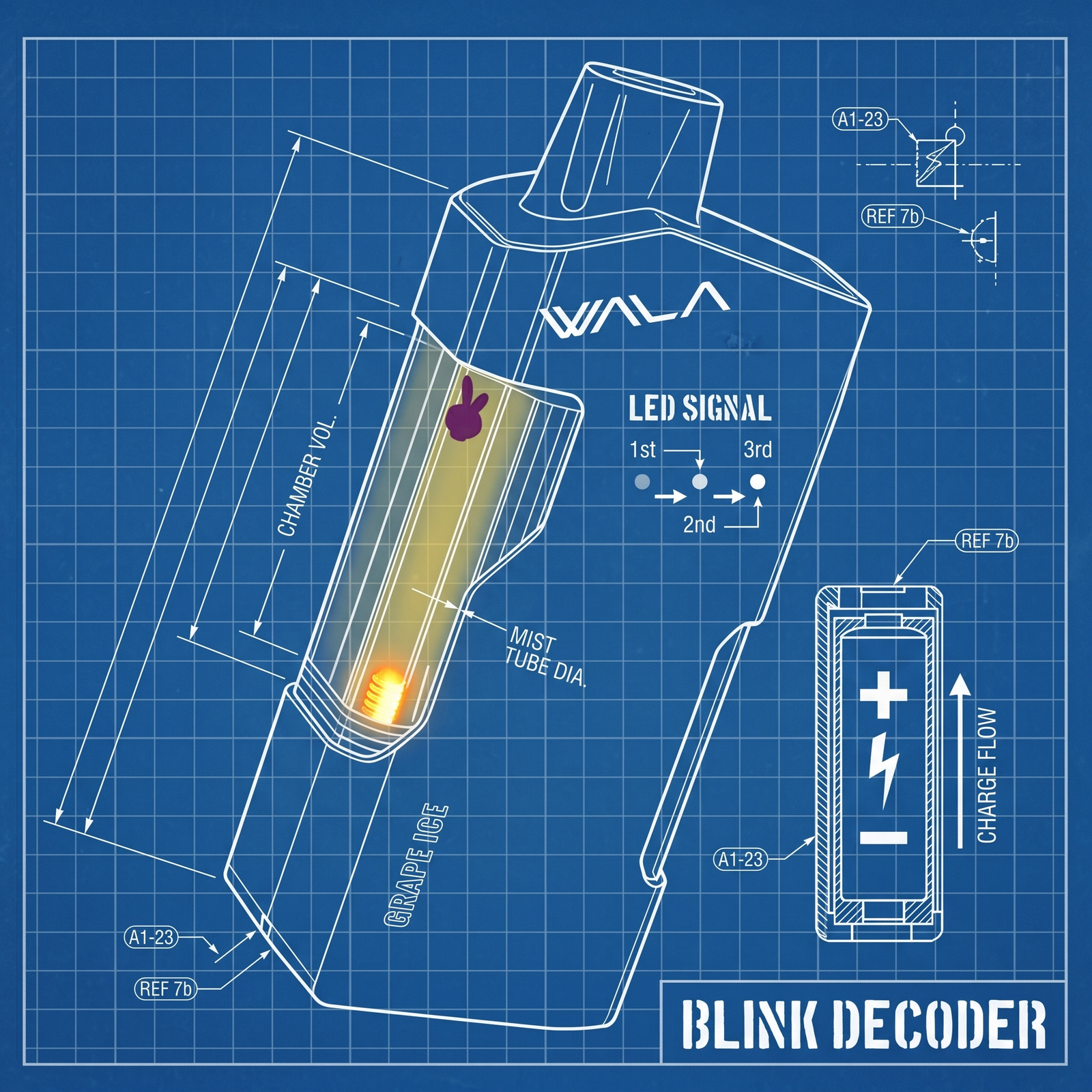
The light is a status message, but manufacturers do not share one universal code. Three slow pulses on one device may mean “low battery”; on another, they may flag a puff timeout, connection fault or protection event. Colour helps — white, blue, green, red and amber often mean different things — yet the number of flashes, their speed, and whether they occur during a draw or charging matter too.
Inside the case are a lithium cell, charging circuit, airflow sensor, coil and wicking material. If the board detects something unsafe, cutting power and blinking is often preferable to continuing. That can be annoying when liquid remains, but forcing puffs rarely fixes the underlying cause.
A quick photo of the flashes and a note about when they happen can save time later. Was the device cold, hot, nearly empty, freshly dropped, plugged in, or just removed from a tight pocket? Those clues often narrow the cause faster than pressing the button repeatedly.
Blinking does not automatically mean you did anything wrong. Devices get sat on, carried through pockets, left in warm cars, shared between people with different drawing styles, or charged with worn cables. Some faults settle quickly; others are a circuit doing its job.
Quick Safety Check First
Do not charge or continue using the device if any of these apply:
- The casing is swollen, bent, cracked, dented or punctured.
- It feels uncomfortably hot while idle, not merely warm after use.
- Liquid comes from the battery end, USB-C port, seams or vents.
- There is a sweet chemical smell, burning-plastic smell or scorch mark.
- It hisses continuously, spits hot liquid or behaves unpredictably.
- It has been through a washing machine, salt water or a hard fall onto concrete.
- The USB-C port is badly loose, corroded or blocked.
If none apply, dry the outside, wash your hands and work through the checks below. Never open the shell, remove the battery, poke into vents or attempt a refill. Disposables are sealed for safety.
LED Pattern Decoder
Use this as a starting point, then confirm against the packaging or seller’s support page because coding varies by brand.
| LED pattern | Most likely meaning | What to try |
|---|---|---|
| Two or three slow blinks during a draw | Low battery, puff timeout or airflow interruption | Charge briefly and take slower, shorter draws |
| Rapid flashing when you inhale | Protection lockout, short-circuit warning or no airflow detected | Check the inlet, cool the device, inspect the port, test gently once |
| Repeated flashing while plugged in | Charging fault, dirty port or battery below recovery threshold | Unplug, inspect lint, wait until room temperature, try a low-power cable |
| Solid red or red blink after charging | Still low, charge error or tired cell | Disconnect after ten minutes, let it settle, retry once |
| Alternating colours | Charging progress on some models; fault mode on others | Watch for two minutes; unplug if it heats or cycles endlessly |
| No light at all | Flat battery, failed sensor, broken cable or exhausted device | Try another cable and plug before assuming the device is dead |
A useful test: does the pattern change after clearing airflow, cooling or a short charge? If not, an internal part may have failed.
Fix 1: Clear The Airflow And Sensor
Start with the least invasive possibility. Remove every transport sticker, silicone bung and mouthpiece cover. Find the small inlet near the base — often beside USB-C — and make sure your fingers are not covering it.
Pocket fluff, sand, servo forecourt dust or crumbs from a ute console can sit across the inlet until the sensor thinks you are not inhaling. Hold the vape upright, blow gently through the mouthpiece onto a tissue, then wipe the openings with a dry cotton bud. Do not use pins, needles or compressed air at close range.
Take one slow two-second puff. If vapour returns, keep draws relaxed for the next few sessions. Hard pulls can flood a coil and turn an airflow problem into a burnt taste.
This is also worth checking after a beach day, worksite visit or long drive. Grit does not need to enter the tank to cause trouble; it only has to sit over the sensor or inlet.
Fix 2: Charge With Low Power And A Timer
If the device has USB-C, connect it only when it is cool, dry and undamaged. Use the supplied cable where possible, or a known-good cable with a reputable phone adapter. A laptop USB-A-to-C port or ordinary car USB point is generally gentler than a high-output fast charger. Avoid unknown servo-counter cables and chargers designed for laptops or tablets.
Set a timer for ten to twenty minutes. Leave the vape on a hard bench away from bedding, carpet, curtains and petrol fumes, and stay nearby. Slight warmth can be normal; hot-to-hold is not. Unplug if the light flashes irregularly, the shell heats quickly or you smell something unusual.
After charging, wait two minutes, then take two gentle draws with a thirty-second pause between them. Popular larger-capacity devices commonly sit around A$39–A$69 in Australia, so ten careful minutes beats an overnight gamble.
Fix 3: Manage Australian Summer Heat
Heat is a major reason a vape blinks or hits strangely during summer. A parked car, dashboard, metal ute tray or sunny side of a servo can push a device well above comfortable room temperature. Closed cars and garages can exceed 40°C, stressing the cell, thinning e-liquid and making wicking unpredictable.
If it has been in direct sun or a hot car, leave it upright in shade until it feels close to normal indoor temperature — roughly 20–25°C. Do not refrigerate or freeze it, run water over it, or charge it warm. Once cooled, wipe condensation from the outside and try one short draw.
For storage, use a shaded bag pocket or drawer. Keep it upright, capped and away from keys, coins and loose batteries.
Fix 4: Rule Out Low Liquid Or A Burnt Coil
Sometimes the clue is taste rather than code. Thin vapour or papery flavour often means a dry wick or nearly finished tank. Rest the device upright for twenty minutes, then try two short draws. If harshness disappears, the coil needed time to re-wet. A burnt taste that remains after resting usually means permanent coil damage.
Advertised counts are controlled-condition estimates, not promises. Draw length, pauses, sharing and heat change real life. A WALA POP 10000 Puffs is rated at 10000 puffs and often listed around A$52; an Alibarbar Ingot 9000 is a 10000-puff class model that may appear near A$60–A$55 depending on availability. Treat those as budgeting examples, not guaranteed output.
If it blinks only when almost empty, the battery may be healthy while the liquid or coil is finished. More charging will not revive a scorched coil. If you go through a device quickly, track puffs for a week before buying a larger format. A 10000-puff model can be better value than two smaller bars, but only if storage, charging and drawing habits let it reach a realistic share of its rated life. If you go through a device quickly, track puffs for a week before buying a larger format. A 10000-puff model can be better value than two smaller bars, but only if storage, charging and drawing habits let it reach a realistic share of its rated life. Compare formats through Cloud Collective’s browse-all page before replacing anything.
When To Reset, Replace Or Dispose Safely
Some boards lock out after long chains of puffs, a drop, brief short, overheating or very low battery. A gentle reset is patience, not force: stop using it, let it return to room temperature for twenty to thirty minutes, clear the inlet and port, charge for ten to fifteen minutes if undamaged, unplug, then take one short draw after two minutes. Never tap it sharply, squeeze the shell, heat it or keep sucking at the mouthpiece.
Replace it if the same fault returns every time, vapour never comes back, or it drains unusually fast. A battery that works for only a few puffs after charging has lost capacity.
Used vapes are battery waste and e-waste, not household rubbish or kerbside recycling. Keep the device cool and upright, tape exposed terminals if your council asks, and take it to a battery bin, community recycling centre or council e-waste drop-off. If it is swollen, leaking or hot, seek advice before transporting it. If vaping feels like a chore, a GP or quit-support service can help without judgement.
Common Mistakes To Avoid
- Charging a hot device. Cooling comes first, especially after a parked car or beach trip.
- Using a fast-charge brick. Higher output can stress a small cell and trigger more faults.
- Poking ports or airflow holes. Metal objects deform contacts and can cause shorts.
- Chain vaping to “test” it. Long draws dry the wick and increase heat.
- Leaving it charging overnight. Supervision and a timer matter more than trusting the circuit.
- Choosing an unknown import to save A$10. Poor quality control creates frustration and risk.
FAQ
1. What do three blinks on a vape mean?
It depends on the brand, but this commonly indicates low battery, a puff-timeout cut-off or an airflow/connection fault. Clear the inlet, let the device cool, charge briefly with a reputable low-power adapter, then test once with a gentle draw. Check brand support if it repeats.
2. Why does my vape blink while charging?
Flashing can show normal progress on some models, but endless cycling may mean a dirty port, poor cable contact, a deeply discharged cell or charging fault. Unplug, inspect the port, let it reach room temperature and try another known-good low-power cable for ten minutes. Stay nearby and disconnect if it gets hot.
3. Can I use my phone charger?
Often yes, if the adapter is reputable, undamaged and operating in normal phone-charging mode. The safer setup is a supplied or quality USB-C cable, certified wall adapter, hard surface and supervision. Avoid fast-charge bricks, unknown cables, bedding and carpet. If the adapter becomes unusually warm or the vape’s indicator behaves oddly, stop and try a lower-power source instead. If the adapter becomes unusually warm or the vape’s indicator behaves oddly, stop and try a lower-power source instead.
4. Is vaping legal in Australia in 2026?
Nicotine vaping products remain regulated under the federal TGA framework, with state and territory rules affecting supply, possession channels and enforcement. Settings have changed substantially and differ by location. Check official current guidance and deal only with retailers operating within the applicable framework.
5. How many puffs will a WALA POP 10000 really provide?
It is rated at 10000 puffs, but real-world results vary with draw length, pauses, heat, storage, sharing and whether the battery lasts as long as the liquid. Shorter draws and cool upright storage give the device its best chance of approaching the label.
6. Why does my vape taste burnt even when there is liquid left?
“Full” does not guarantee the wick is wet when you inhale. Long draws, chain vaping, restricted airflow, heat or carbon build-up can expose the coil despite visible liquid. Rest it upright for twenty minutes and try two light draws; persistent burning usually means coil damage.
7. How should I throw out a blinking or dead vape?
Do not put it in household recycling or general rubbish. Treat it as lithium battery waste and take it to a battery or e-waste collection point, community recycling centre or council drop-off. If it is swollen, leaking or hot, handle it cautiously and ask your council first.