
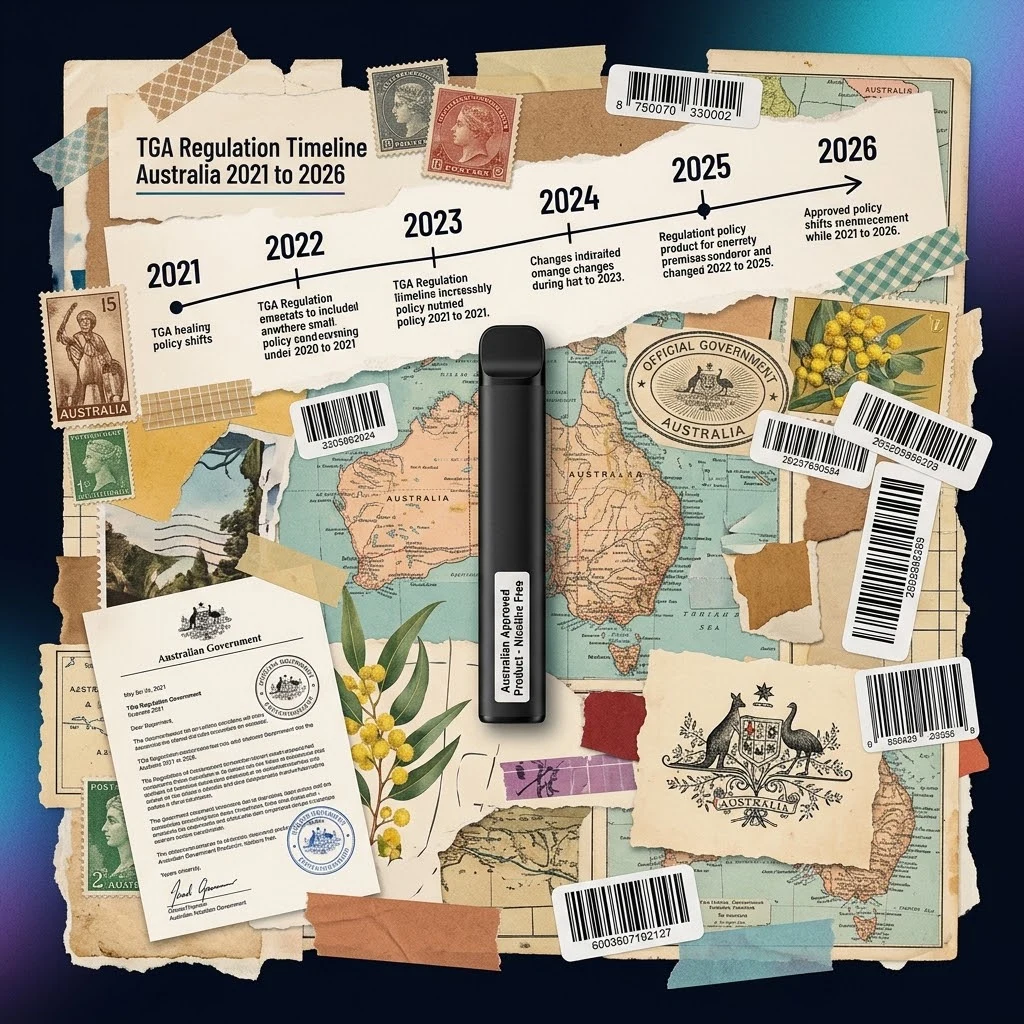
TGA Regulation Timeline 2021–2026: How Australian Vape Laws Got Here
The Short Answer
Australian vaping law since 2021 has moved in one direction: from a loose, retail-driven market toward the tightest regulatory framework in the country’s history — with 2024 as the turning point when nicotine vapes moved onto a TGA prescription-based model, non-prescription sales and imports were restricted, and the ABF began enforcing the import side. The years before 2024 were a long signalling period; 2024 delivered the structural change; 2024–2025 brought successive rounds of tightening; and 2026 (at the time of writing) sits inside a framework that is still evolving. Anyone who tells you “the rules are settled” hasn’t been watching the timeline. The Department of Health and Aged Care confirms the 2024 shift: all vapes and vaping products can now only be sold in a pharmacy for helping people quit smoking or manage nicotine dependence.
1. Why the Timeline Matters
Australian vape regulation is not a single law you can read once and memorise. It’s a sequence of regulatory moves — and the sequence matters, because each move changed what the previous one meant.
Understanding the timeline helps in three practical ways:
- It explains the present. Almost every confusing detail of today’s rules — why imports are risky, why sellers come and go, why enforcement is uneven — is a residue of how the framework got built.
- It kills the “it used to be fine” myth. The market conditions from a few years ago are gone, and the direction of travel tells you they’re not coming back.
- It keeps you honest about “current rules.” If you understand that the framework has changed repeatedly and is still moving, you’ll verify before you buy or import — which is exactly the habit the authorities expect.
One caveat before the timeline: this is a framework-level overview, not a legal instrument. The TGA publishes official timelines and guidance documents; where precision matters, that’s the source to read.
2. 2021–2023: The Signalling Era
Before the current framework existed, nicotine vapes sat in a looser supply environment — retail availability was broader, imports flowed through channels that later closed, and the regulatory picture was fragmented between federal and state rules.
The defining feature of 2021–2023 wasn’t what the law did; it was what the regulator said it would do. Across these years:
- Nicotine was already inside the therapeutic goods system. Because nicotine is a scheduled substance, vaping products that deliver it were never truly “unregulated” — they were regulated but lightly enforced.
- The direction was signalled well in advance. The TGA had long flagged its intention to wind down the loose environment and bring nicotine vapes under the formal medicines framework.
- The market ran ahead of the rules. A retail vape culture grew up in the gap between signalling and enforcement — which is exactly the gap that 2024 closed.
The honest characterisation of this era: a long run-up, with the regulator openly building toward the change that landed in 2024.
3. 2024: The Turning Point
2024 is the year everything structural happened. In a single stretch of regulatory change, the TGA moved nicotine vaping products onto a prescription-based model:
- Non-prescription sales became restricted. The casual retail baseline that existed before 2024 stopped being the lawful default.
- Imports were restricted too. Personal imports of nicotine vapes came inside the same tightened framework.
- The ABF was empowered to enforce the import side. The Australian Border Force became the practical enforcement arm — which is why parcel screening and seizure risk became part of the everyday conversation about vaping.
Three things about 2024 are worth underlining:
- It was a framework change, not a ban. Adult vaping remained legal; what changed was how products may lawfully be supplied and imported.
- It was a phase-in, not a switch-flip. The model arrived in stages, and the detail kept moving through the following year.
- It was enforceable. The new rules came with a border agency attached — which is why 2024 is when “I’ll just order it online from overseas” stopped being a reliable strategy.
4. 2024–2025: Successive Rounds of Tightening
The turning point was followed by successive rounds of refinement — a period of almost continuous adjustment as the detail of the framework was worked out in practice.
What changed across these rounds:
- What retailers could rely on. Each round altered the conditions under which supply could lawfully happen, and the retail landscape shifted accordingly.
- What importers could rely on. The import rules were adjusted repeatedly, which is why “the import rules changed in 2024” is a statement of direction, not a single timestamped law.
- What consumers could rely on. Products and channels that were fine at the start of the period weren’t necessarily fine by the end of it.
The pattern across 2024–2025 was consistent: momentum toward tighter control of supply. If you only remember one thing about this period, remember that — it’s the thread that ties every individual change together.
5. 2026: The Current Framework
At the time of writing, the framework stands like this:
- The prescription-based model remains the foundation. Non-prescription sales and imports stay restricted, and the ABF continues to enforce the import side.
- The framework is still moving. Updates have continued into the current year, and there is no reason to expect the sequence to have stopped.
- The authoritative sources are unchanged. For supply rules, the TGA website; for import specifics, the ABF website. Those two pages are the “current rules,” and everything else — including this article — is a snapshot.
The honest summary of the 2026 position: the direction set in 2024 is intact, the details keep getting refined, and “verify current rules” is not cautious advice — it’s the only accurate instruction.
6. What the Timeline Means for Adult Vapers
A regulatory timeline only matters if it changes what you do. Translated into daily practice:
- Buy from real, verifiable sellers. The compliant channel is a retailer that verifies age, shows its policies and ships transparently. The alternative — social media sellers, marketplace listings, mystery websites — is exactly where the post-2024 enforcement lands hardest on buyers.
- Expect age verification, always. 18+ checks at checkout aren’t a hurdle; they’re the point where the framework meets you as a customer.
- Don’t gamble on imports. The tightened personal import rules make overseas ordering a genuine risk, not a clever loophole.
- Genuine product matters more than ever. Tightened supply channels push counterfeits into the grey market — if a price looks too good to be true, it’s probably a fake wearing a real name.
That’s the standard Cloud Collective operates to: 18+ verification at checkout, genuine stock from our Sydney warehouse, tracked discreet shipping Australia-wide, and free shipping over A$100. Our compliance page walks through how a properly run Australian retailer handles age checks, warnings and the regulatory basics — worth a read before you order anywhere, including from us.
7. The State Layer: A Parallel Timeline
The TGA timeline is national, but it runs alongside a parallel timeline of state and territory rules. States and territories layer their own retail rules, public-use restrictions and penalties on top of the federal framework — and they’ve been tightening on their own schedules:
- Western Australia is the strictest jurisdiction in the country.
- Most states ban vaping wherever smoking is banned — restaurants, public transport, indoor spaces.
- Several states, including NSW and Victoria, treat vaping while driving like phone use under distracted-driving laws.
- Employers set their own workplace rules on top of everything else.
The interaction: the TGA decides what may lawfully be supplied at a national level; your state decides the conditions around that supply where you live. A purchase that’s lawful federally can still land you in local trouble if it ignores state rules — which is why responsible vapers keep one eye on the TGA website and one on their state government’s current guidance.
8. FAQ
What is the TGA and why does it regulate vapes?
The Therapeutic Goods Administration is Australia’s regulator for medicines and therapeutic devices. Because nicotine is a scheduled substance, vaping products that deliver it fall inside the TGA’s territory — which is why vape rules are written like medicine rules.
What changed in Australian vape law in 2024?
2024 was the turning point: nicotine vapes moved onto a prescription-based model, non-prescription sales and imports were restricted, and the ABF began enforcing the import side of the new framework.
What were the rules before 2024?
A looser, retail-driven supply environment that the TGA had long signalled it would wind down. Nicotine was already inside the therapeutic goods system, but enforcement was lighter and imports flowed through channels that later closed.
Is the TGA still changing the rules in 2026?
Yes. The prescription-based model remains the foundation, but the framework has been updated repeatedly since 2024 and continues to evolve. The TGA and ABF websites are the authoritative sources for current rules.
Do TGA rules apply in every state the same way?
No. The TGA framework is national, but states and territories add their own retail, public-use and enforcement rules — Western Australia is the strictest. Always check your state’s rules as well as the TGA’s.
Is vaping being banned in Australia?
No — adult vaping is legal, but tightly regulated. The direction since 2024 has been toward stricter control of supply and imports, not prohibition of adult use. Expect the rules to keep evolving; verify current requirements before you buy or import.